In the town of Lancaster inside Kentucky’s Bluegrass region, lies a veteran’s memorial outside of Lancaster Elementary School. It consists of two large naval guns. For decades children have climbed over the relics from a long-ago conflict, with little knowledge of their past. Although quiet now, the guns quite possibly boomed during World War II, protecting American merchant ships from attack.
America’s merchant fleet goes to war
December 21, 1940. 2:55 p.m. Pacific Ocean. Approximately 220 miles from Freetown, Sierre Leone. “The wind was calm and the sea smooth, with a light swell” reported the captain. Suddenly an explosion rocks the steam tanker Charles Pratt– flying a Panamanian flag but crewed by Americans. A torpedo rips into the hull with a shower of oil and debris raining onto the decks. Immediately a fire breaks out. The captain orders abandon ship. Before all could make it into the lifeboats; however, a second torpedo strikes. The crew of forty-two would lose two men.1
The sudden attack on the Pratt by a German U-boat foreshadowed what was to soon come for American vessels.
Less than a year later, the United States officially entered World War II. The nation’s merchant fleet, organized into the Merchant Marine, became mobilized, tasked with delivering troops and crucial supplies to all theaters of the war.
Now legitimate targets, commercial ships flying the stars and stripes required protection.
An immediate solution was to mount weapons onboard. The government outfitted ships with a hodgepodge of antiquated guns brought out from storage. Personnel from the Naval Armed Guard, a special branch of the Navy, manned these weapons but in case of combat casualties, the guard trained some of the merchant crew. This assignment was less than desirable, its sailors essentially the Navy’s “stepchildren.”2
Several months into the war, however, the Navy’s Bureau of Ordinance decided to design and build a gun specifically intended for merchant use. This weapons system had to be simple to operate and easy to mount.
The Navy already had in its arsenal the 5-inch 38-caliber gun. All it needed were a few modifications.
Defense from sea and air
Introduced in 1934, the 5″/38 was a dual-purpose gun, able to engage both surface and air targets. It featured an electric-hydraulic power rammer which quickly rammed shells into the chamber. This proved especially useful when operating against aircraft, with the barrel elevated to high angles. Depending on the model and crew’s training, its rate of fire was 12 to 22 rounds per minute.
Most American warships were armed with the 5″/38 in World War II. As the standard armament for newly constructed vessels from destroyers to aircraft carriers, the gun saw action in all theaters, proving itself highly effective in combat.
In total the Navy procured over 8,000 of these guns from 1940 to 1945. They consisted of many different models based on the type of mount, number of barrels (single or twin), and protection- either open or enclosed in a shield. Models were designated as Mark (Mk) and a number, whereas variations of a basic design were Modifications (Mod).
There was no major deviation from the prototype gun for almost a decade. Then came change in mid 1942.
The intent of the Mk 37 5″/38 was to arm merchantmen and other auxiliaries. It consisted of a single gun on a narrow working platform, open without a shield, mounted onto a base ring. This allowed for quick installation on ship decks. Lacking a remote power control system, a crew of 15 operated the gun in local control. Targets had to be engaged with telescopes or open gun sights without the help of computerized systems.


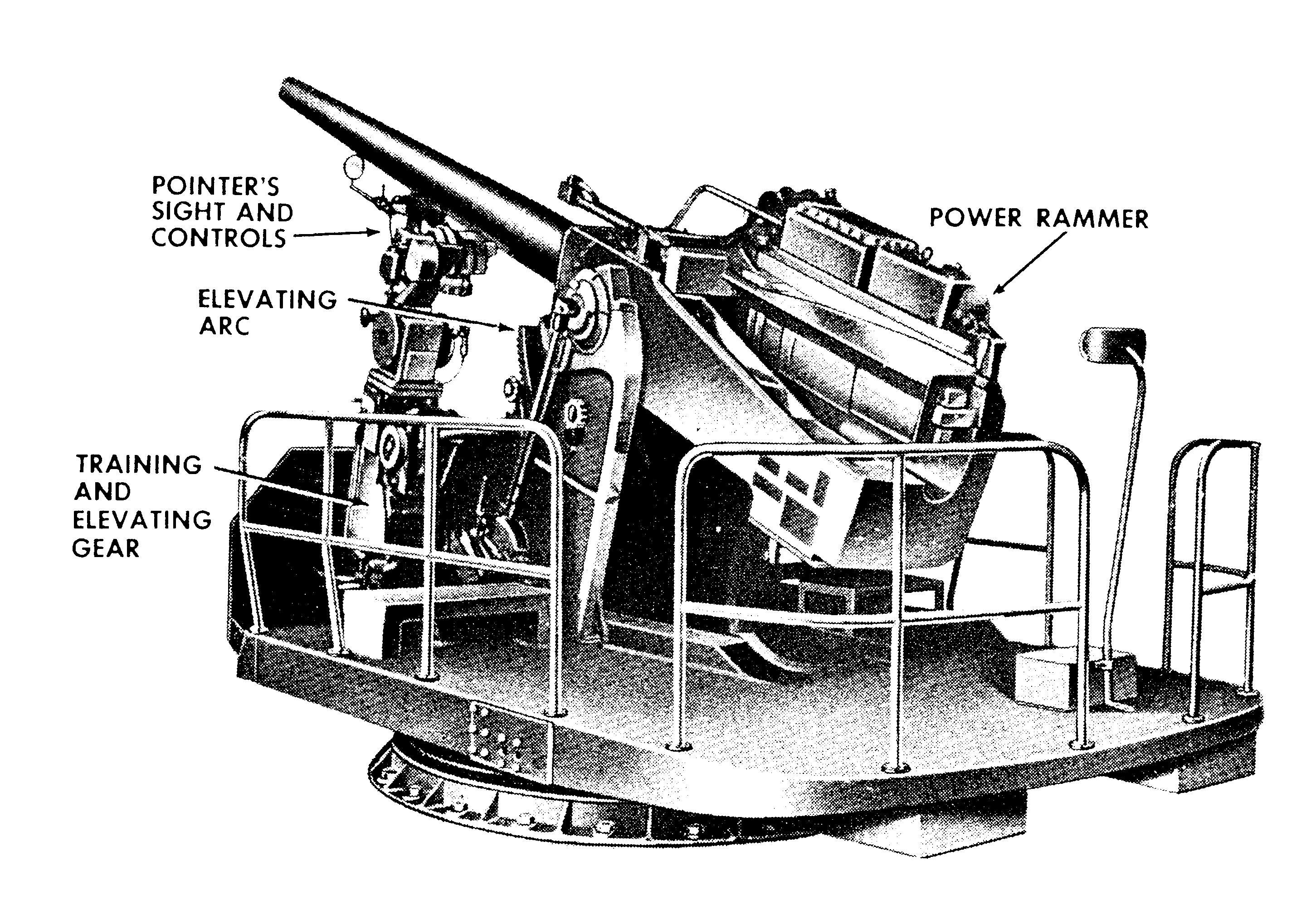
Tasked with its production was Northern Ordnance of Minneapolis, a subsidiary of Nothern Pump Company. The company built over 3,600 of these guns from 1942 to 1945. Of which, only about 1,600 actually armed merchantmen.3
When the war ended in 1945, so did the need to arm the merchant navy. Naval Armed Guards crew quietly departed from their ships. So too did the guns they manned, ending up in storage or as scrap.
The guns of Lancaster Elementary
Eventually two 5″/38 Mk 37 guns made their way to Lancaster in Garrard County, Kentucky. For well over five decades, they have sat in front of Lancaster Elementary School. Countless is the number of imaginary ships and airplanes destroyed in pretend battles.
How the guns arrived at the school is a story in itself.4 Ironically, the guns did not come from the Navy but instead, the Army.
During the tenure of Kentucky governor Louie Nunn, 1967 to 1971, the Garrard County Civil Defense filed a request with the state to receive a piece of military ordnance. The organization sought to erect a veteran’s memorial.
After some correspondence the state located an available gun. There were two 5″/38s at, of all places, Fort Knox. They belonged to the Patton Museum and were located on its parking lot. At the time, the museum was constructing a new building, opened in 1972, and was in the process of relocating its collections. More than likely, the guns came from Naval Ordnance Station Louisville which tested weapons at Fort Knox.
On a mild day in January 1971, a party of men set off from Garrard County for the fort, with the intention of collecting one of the pieces. Their convoy consisted of a flatbed trailer, a sheriff’s car, and a State Police car. Upon arrival a large crane and company of army engineers awaited, whom the Garrard men directed to load the gun on the right.

To their shock, an army officer replied “no, you’re taking them both!” The civilians agreed.
During the loading process one of the trailer’s tires popped. The flat was changed out. Overloaded, over width, and over height, the Garrard men took a risk in leaving with the trailer, but they did so at night. Blue police lights illuminated the road back to Lancaster.
Safely reaching their destination, the party offloaded the guns the next day. Over a year later, on Memorial Day, May 29, 1972, American Legion Post No. 35 and the Garrard County Civil Defense dedicated the memorial.
Originally the Patton Museum loaned the guns to the City of Lancaster, with the intention of ultimately donating them. It would take over two decades for the transfer to happen. The museum first had to request permission from the army and then in March 1997, the Lancaster City Council approved the gift- a conditional donation.
As part of the terms, the city agreed to first consult the federal government if it ever decided to dispose the guns.5


Sources
- For a detailed account of the sinking of the sinking of the Charles Pratt, read Ships of the Esso Fleet in World War II (published by the Standard Oil Company, 1946), pp.46-50. Online: https://www.google.com/books/edition/Ships_of_the_Esso_Fleet_in_World_War_II/e3JMAAAAMAAJ?hl=en&gbpv=1 (accessed March 17, 2025).
- Beverley L. Britton, Lieutenant Commander, “Navy Stepchildren: The Armed Guard,” in Proceedings, December 1947, volume 73/12/538. Available online at: https://www.usni.org/magazines/proceedings/1947/december/navy-stepchildren-armed-guard (accessed June 16, 2025).
- Buford Rowland and William B. Boyd, U.S. Navy Bureau of Ordnance in World War II (Washington, D.C.: Government Printing Office, 1953), p.260. Online: https://www.google.com/books/edition/U_S_Navy_Bureau_of_Ordnance_in_World_War/EqNZ5hjPOVMC?hl=en&gbpv=1&bsq=mark%2037 (accessed March 16, 2025).
- An brief undated history of the guns is located at the Garrard County Public Library, in Lancaster, Kentucky. It is located in the local history section in a file marked “WWII- USS Garrard #1.”
- “Two Naval Guns Loaned to Lancaster in 1971, Donated to City,” in The Central Record (Lancaster, Kentucky), March 6, 1997. Retrieved from: https://www.newspapers.com/image/1140717526/ (accessed June 13, 2025).